The Color Wheel: How It Works + Interactive Guide
The color wheel is a circular diagram that organizes colors by their relationships. It shows how colors connect, which pairs create contrast, and how to build harmonious palettes. Understanding the complementary colors relationship is central to using the color wheel effectively.
What Is a Color Wheel?
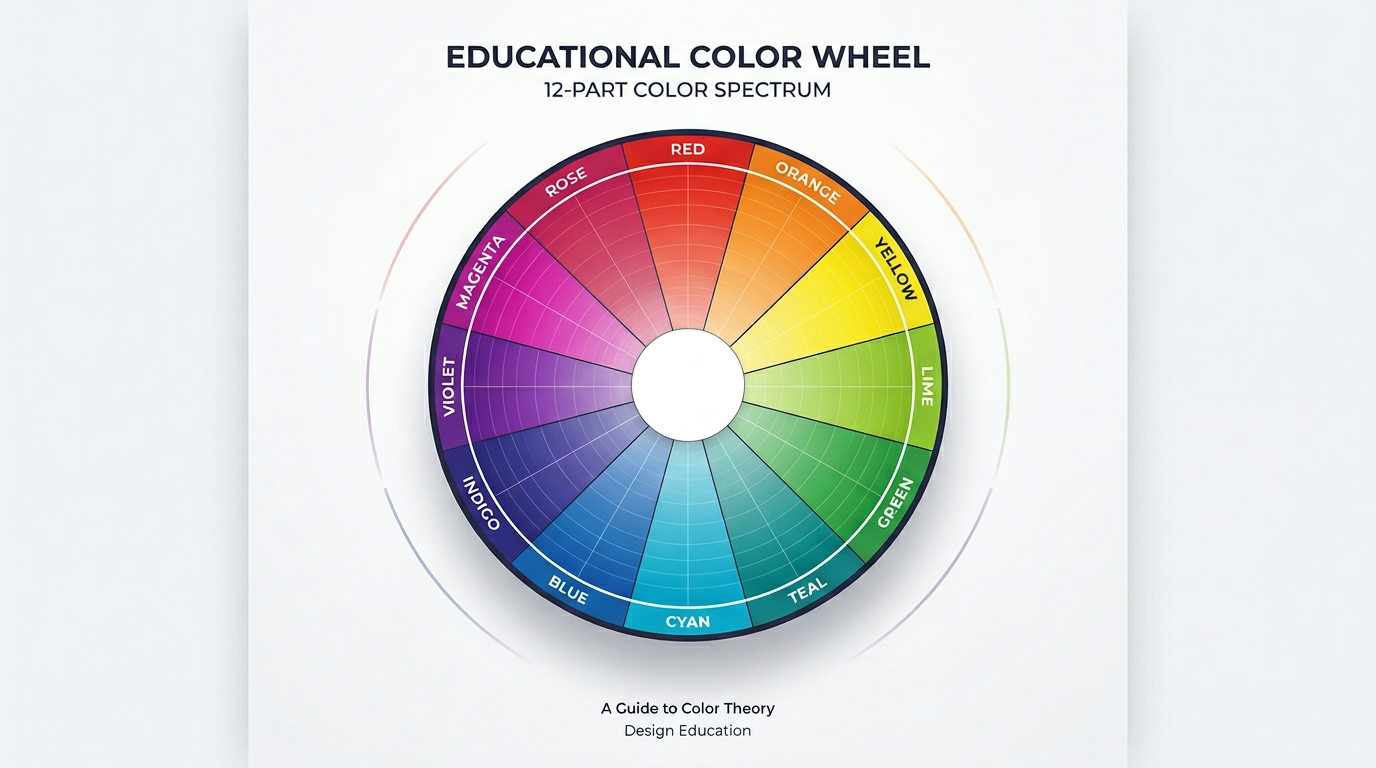
A color wheel arranges hues in a circle so that relationships between colors are visible. Primary colors sit at key positions; secondary and tertiary colors fill the gaps. The wheel makes it easy to find complementary, analogous, triadic, and other color schemes.
Interactive Color Wheel
Click any segment on the wheel below to see its complementary pair. The line connects the two opposite colors.
Selected: —
Complement: —
Primary, Secondary, and Tertiary Colors
On the RYB wheel, red, yellow, and blue are primary. Orange, green, and purple are secondary. Tertiary colors (red-orange, yellow-green, etc.) sit between primary and secondary. Each segment has a complementary color on the opposite side.
Complementary Colors on the Wheel
Complementary colors sit 180° apart. Draw a line through the center from any color—the color at the opposite end is its complement. This creates maximum contrast. Red and green, blue and orange, yellow and purple are the classic pairs.
Other Color Relationships
Split-complementary uses one color plus the two adjacent to its complement. Triadic uses three colors 120° apart. Analogous uses adjacent colors. Learn more in our split-complementary and triadic guides.
Complementary Color Finder
Enter a hex code or pick a color to see its complement, split-complementary, and triadic palettes.
Complementary
Split-complementary
Triadic
RYB vs RGB vs CMYK
RYB (red, yellow, blue) is for traditional art and paint. RGB (red, green, blue) is for screens and additive color. CMYK (cyan, magenta, yellow, black) is for print. Complementary pairs differ slightly between models, but the principle of opposites is the same.
Related Articles
- Split-Complementary Colors Explained
- Triadic Color Scheme: Guide + Examples
- Color Theory Basics
- Complementary Color Pairs
Frequently Asked Questions
How does the color wheel work?
The color wheel arranges colors in a circle by their hue. Colors opposite each other are complementary. Adjacent colors are analogous.
What is the difference between RYB and RGB?
RYB is the traditional artist's color wheel (red, yellow, blue) for paint. RGB is for digital screens (red, green, blue) and uses additive color mixing.