Hue, Saturation, and Value Explained
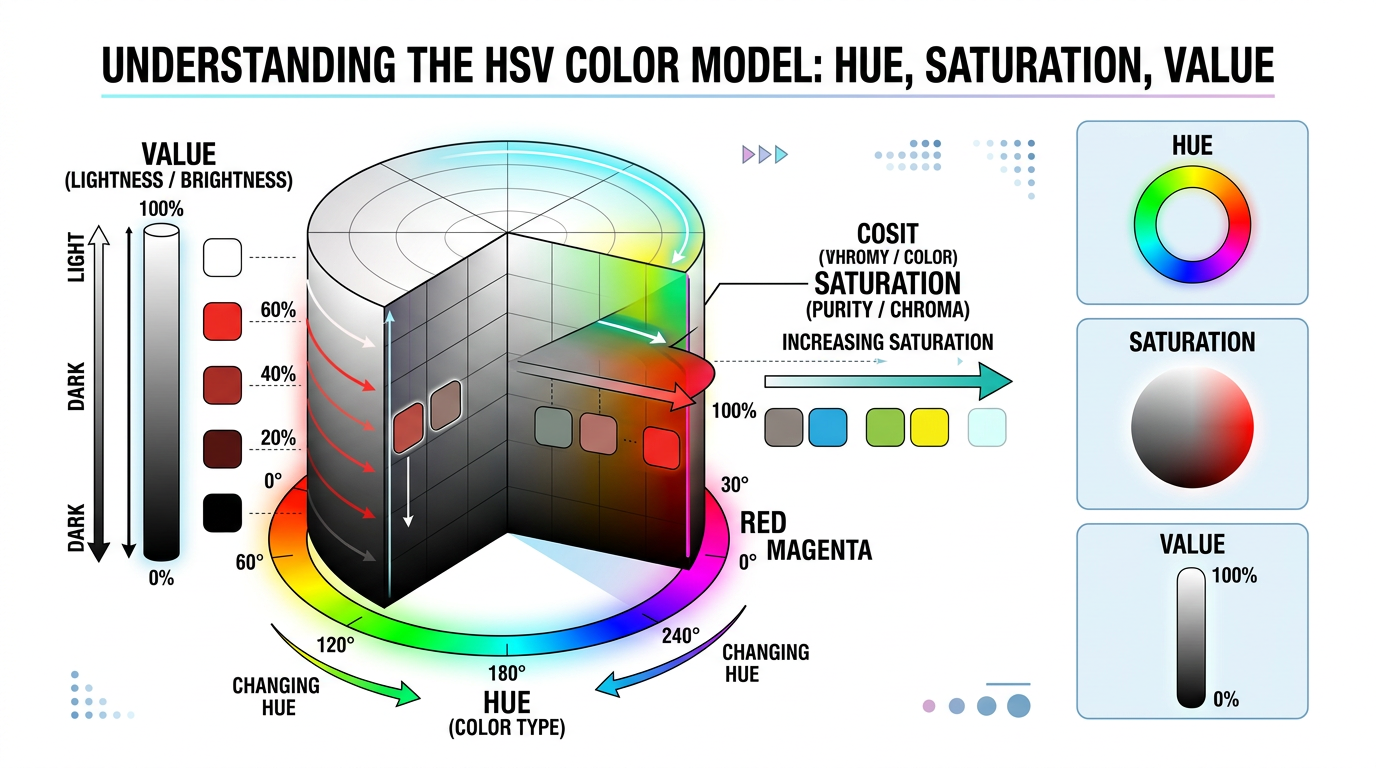
Hue, saturation, and value (HSV) are the three dimensions of color. Hue is the color itself (red, blue, green). Saturation is the intensity or purity of the color. Value is the lightness or darkness. Understanding HSV is essential for working with complementary colors and creating harmonious palettes.
What Is Hue?
Hue is the position on the color wheel, typically measured in degrees (0–360). Red is around 0°, green around 120°, blue around 240°. Complementary colors have hues 180° apart. Our color finder uses hue rotation to calculate complements.
What Is Saturation?
Saturation (or chroma) is color intensity. 0% saturation is gray; 100% is pure color. Desaturated colors are muted; saturated colors are vivid. Tints (add white) and shades (add black) reduce effective saturation.
What Is Value?
Value (or lightness) is how light or dark a color is. Black has 0% value; white has 100%. Value affects contrast and readability. WCAG guidelines use luminance contrast for accessibility.
HSV in Design
When creating color schemes, adjust saturation and value for harmony. Complementary pairs can use different saturations for subtlety. The Munsell Color System formalizes these concepts.
Try It: Find Complementary Colors
Enter a hex code or pick a color to see its complement, split-complementary, and triadic palettes.
Complementary
Split-complementary
Triadic
Related Articles
Frequently Asked Questions
What is hue in color?
Hue is the color itself—red, blue, green, etc. It's the position on the color wheel, typically measured in degrees from 0 to 360.